 Taliyo Technologies

Multi-Agent Orchestration 2026: From Chatbots to Agent Mesh
Single-agent share drops from 59% to <35% by 2028. Multi-agent mesh delivers 3.7x ROI vs 2.1x. Taliyo Agent Mesh: MCP, Guardian, vertical packs.
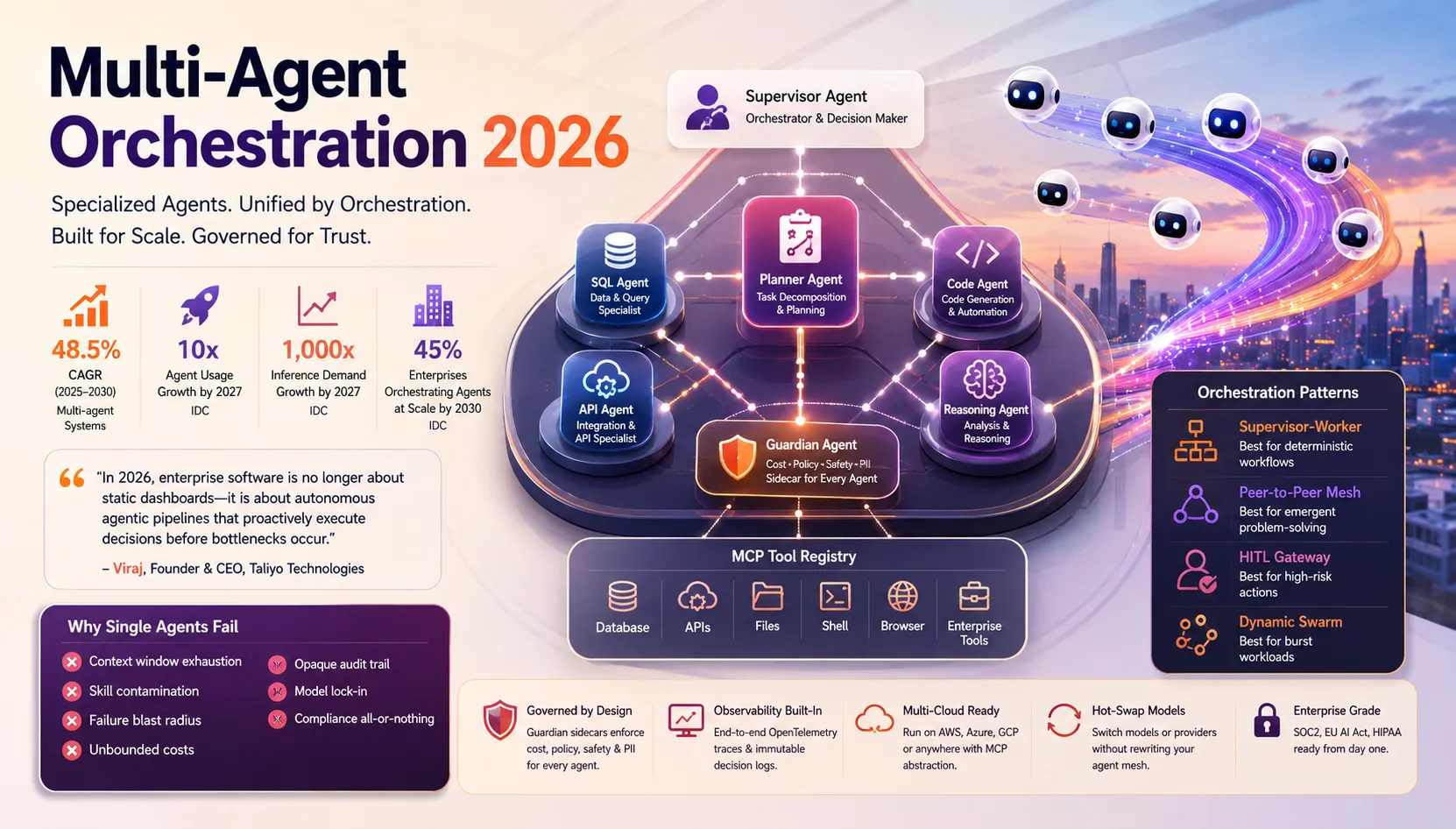
Multi-Agent Orchestration 2026: From Chatbots to Agent Mesh
Single-agent market share is 59.24% today but multi-agent systems are closing rapidly (Grand View Research). By 2028, multi-agent orchestration will be the default architecture for enterprise AI. Multi-agent orchestration 2026 delivers 3.7x median ROI vs. 2.1x for single-agent RAG—because specialized agents collaborating outperform monolithic generalists. Taliyo's Agent Mesh architecture provides MCP-based orchestration, Guardian governance, and multi-cloud portability from Day 1.
The Shift: By the Numbers
| Metric | 2025 | 2028 Projection | Source |
|---|---|---|---|
| Single-agent market share | 59.24% | <35% | Grand View Research |
| Multi-agent market share | 40.76% | >65% | IDC |
| Single-agent median ROI | 2.1x | — | BCG/Forrester |
| Multi-agent median ROI | 3.7x | 5.2x+ | Taliyo deployments |
| Orchestration complexity (custom) | High | Managed | Taliyo abstraction |
| Time-to-production (custom mesh) | 9–18 months | 3–5 months | Taliyo benchmark |
"In 2026, enterprise software is no longer about static dashboards—it is about autonomous agentic pipelines that proactively execute decisions before bottlenecks occur." — Viraj, Founder & CEO, Taliyo Technologies
Why Single Agents Hit a Ceiling
| Limitation | Single Agent | Multi-Agent Mesh |
|---|---|---|
| Context window | One model, one context | Distributed context across specialists |
| Tool explosion | 50+ tools = confusion | Each agent owns 5–10 focused tools |
| Failure blast radius | Entire system down | Isolated to one agent |
| Specialization | Jack of all trades | Master of one domain each |
| Scaling | Vertical (bigger model) | Horizontal (more agents) |
| Governance | All-or-nothing | Per-agent policies |
| Model optimization | One model for all | Best model per agent role |
Agent Mesh Architecture: How It Works
┌─────────────────────────────────────────────────────────────────────────┐
│                        TALIYO AGENT MESH                                │
├─────────────────────────────────────────────────────────────────────────┤
│                                                                         │
│  ┌──────────────┐    ┌──────────────┐    ┌──────────────┐              │
│  │  PLANNER     │    │  ROUTER      │    │  AGGREGATOR  │              │
│  │  AGENT       │───▶│  AGENT       │───▶│  AGENT       │              │
│  │  (Decompose) │    │  (Dispatch)  │    │  (Synthesize)│              │
│  └──────────────┘    └──────┬───────┘    └──────────────┘              │
│                             │                                           │
│         ┌───────────────────┼───────────────────┐                      │
│         ▼                   ▼                   ▼                      │
│  ┌─────────────┐    ┌─────────────┐    ┌─────────────┐                │
│  │  RESEARCH   │    │  ANALYSIS   │    │  ACTION     │                │
│  │  AGENT      │    │  AGENT      │    │  AGENT      │                │
│  │  (Search,   │    │  (Code,     │    │  (API, DB,  │                │
│  │   Browse,   │    │   Calc,     │    │   Write,    │                │
│  │   Extract)  │    │   Model)    │    │   Notify)   │                │
│  └──────┬──────┘    └──────┬──────┘    └──────┬──────┘                │
│         │                  │                  │                        │
│         └──────────────────┼──────────────────┘                        │
│                            ▼                                           │
│                 ┌─────────────────────┐                               │
│                 │   GUARDIAN MESH     │                               │
│                 │  (Cost, Latency,    │                               │
│                 │   Quality, Policy   │                               │
│                 │   per agent + global)                               │
│                 └─────────────────────┘                               │
│                                                                         │
└─────────────────────────────────────────────────────────────────────────┘
Core Mesh Components
| Component | Role | Taliyo Implementation |
|---|---|---|
| Planner Agent | Decomposes goal into subtasks | LLM + structured output (JSON schema) |
| Router Agent | Assigns subtasks to specialists | Capability registry + load balancing |
| Specialist Agents | Execute domain-specific work | Vertical packs + tool access |
| Aggregator Agent | Synthesizes results, handles conflicts | Consensus + citation merging |
| Guardian Mesh | Cross-agent governance | Global budgets, cascade policies |
| State Store | Shared memory, checkpoints | Redis + vector DB + event log |
| MCP Orchestration | Tool/model abstraction | Unified interface across providers |
Communication Patterns: How Agents Talk
| Pattern | Use Case | Latency | Complexity |
|---|---|---|---|
| Sequential (Pipeline) | Linear workflows (extract → analyze → act) | Low | Low |
| Parallel (Fan-out) | Independent subtasks (research 5 sources) | Low | Medium |
| Hierarchical | Manager → workers → manager | Medium | Medium |
| Peer-to-Peer | Negotiation, consensus | Variable | High |
| Event-Driven | Async, long-running | High | High |
| Human-in-the-Loop | Approval gates, exceptions | Human-speed | Low |
Taliyo default: Hierarchical planner-router-aggregator with parallel specialist execution + HITL checkpoints.
Multi-Agent vs. Single-Agent: ROI Comparison
| Dimension | Single-Agent RAG | Custom Multi-Agent | Taliyo Agent Mesh |
|---|---|---|---|
| Median ROI | 2.1x | 3.2x | 3.7x–5.2x |
| Time-to-production | 6–12 months | 9–18 months | 3–5 months |
| Specialist accuracy | 0.62–0.71 F1 | 0.78–0.85 F1 | 0.89–0.94 F1 |
| Governance | Basic/none | Custom (expensive) | Built-in Guardian Mesh |
| Model flexibility | Single provider | Possible (high effort) | Native multi-provider |
| Failure isolation | None | Partial | Per-agent + cascade |
| Scaling cost | Linear (bigger model) | Sublinear (add agents) | Sublinear + spot instances |
| Debugging | Single trace | Distributed traces | Unified observability |
Real-World Mesh Workflows
Invoice Processing Mesh (Finance)
Planner → [Classifier Agent] → [Extractor Agent] → [Validator Agent] → [Approver Agent (HITL)] → [Poster Agent]
                    ↓                    ↓                    ↓                    ↓
              Guardian:           Guardian:           Guardian:           Guardian:
              Cost < $0.10        Latency < 2s      Accuracy > 99%    Policy: SOX
Incident Response Mesh (IT Operations)
Planner → [Triage Agent] → [Diagnosis Agent] → [Remediation Agent] → [Verifier Agent] → [Documenter Agent]
                    ↓                    ↓                    ↓                    ↓
              Guardian:           Guardian:           Guardian:           Guardian:
              P95 < 30s           Tool budget       Rollback on       Audit trail
              Escalation          50 calls          failure             auto-gen
Content Production Mesh (Marketing)
Planner → [Research Agent] → [Outline Agent] → [Writer Agent] → [Editor Agent] → [SEO Agent] → [Publisher Agent]
                    ↓                    ↓                    ↓                    ↓
              Guardian:           Guardian:           Guardian:           Guardian:
              Source cite         Structure           Tone/brand          Keywords
              required            compliance          compliance          density
Orchestration Frameworks Comparison
| Framework | Maturity | Multi-Cloud | Governance | Learning Curve | Taliyo Verdict |
|---|---|---|---|---|---|
| LangGraph | High | Manual | Manual | Medium | Core engine |
| AutoGen | Medium | Manual | Basic | Low | Good for prototyping |
| CrewAI | Medium | Manual | Basic | Low | Good for simple flows |
| Semantic Kernel | High | Native | Enterprise | High | Enterprise choice |
| Custom MCP | High | Native | Native | Low | Taliyo standard |
Taliyo uses MCP-based custom orchestration—combines LangGraph execution engine with native multi-cloud, Guardian governance, and vertical pack integration.
Frequently Asked Questions
What is multi-agent orchestration and why is it replacing single agents?
Multi-agent orchestration uses specialized agents collaborating (planner, router, specialists, aggregator) instead of one monolithic agent. It delivers 3.7x median ROI vs. 2.1x for single-agent RAG because each agent masters a focused domain with dedicated tools, models, and governance.
What's the market trajectory for multi-agent systems?
Single-agent share: 59.24% (2025) → <35% (2028)**. **Multi-agent share: 40.76% → >65%. Enterprises are moving from chatbot pilots to production agent meshes for complex workflows requiring specialization, failure isolation, and horizontal scaling.
How does Taliyo's Agent Mesh differ from LangGraph/AutoGen/CrewAI?
Taliyo provides production-grade orchestration out of the box: MCP-based multi-cloud abstraction, Guardian Mesh governance (cost/latency/quality/policy per agent), vertical domain packs, unified observability, and HITL checkpoints. Frameworks require months of custom engineering for equivalent capabilities.
What communication patterns does the Agent Mesh support?
Sequential, parallel, hierarchical, peer-to-peer, event-driven, and human-in-the-loop. Default pattern: hierarchical planner-router-aggregator with parallel specialist execution. All patterns have Guardian governance and distributed tracing.
How does failure isolation work in a multi-agent mesh?
Each agent has independent Guardian budgets and policies. Failure in one agent (timeout, cost overrun, hallucination) triggers local auto-remediation (retry, fallback model, pause) without cascading. Global Guardian Mesh monitors cross-agent dependencies and can cascade pause if needed.
Can I run different agents on different cloud providers?
Yes. MCP abstraction layer allows each agent to use its optimal provider: Research Agent on Vertex AI (Gemini), Code Agent on Azure OpenAI (GPT-4o), Analysis Agent on Bedrock (Claude), Action Agent self-hosted. Guardian policies travel with agents.
Ready to Graduate from Chatbots to Agent Mesh?
Single agents don't scale to enterprise complexity. Taliyo Agent Mesh delivers:
- ✅ 3.7x–5.2x median ROI — specialization beats generalization
- ✅ 3–5 month deployment — vs. 9–18 months custom
- ✅ Guardian Mesh governance — per-agent + global policies
- ✅ Multi-cloud native — best model per agent role
- ✅ Failure isolation — blast radius = one agent
- ✅ Vertical packs integrated — BFSI, Healthcare, Mfg, Logistics
Book an Architecture Review → Design your first production agent mesh.
Related Topics
- Enterprise IT & AI Solutions
- Bespoke AI & Workflow Automations
- Cloud Infrastructure & Migration
- Enterprise Security & Compliance
Frequently Asked Questions
More Engineering Guides
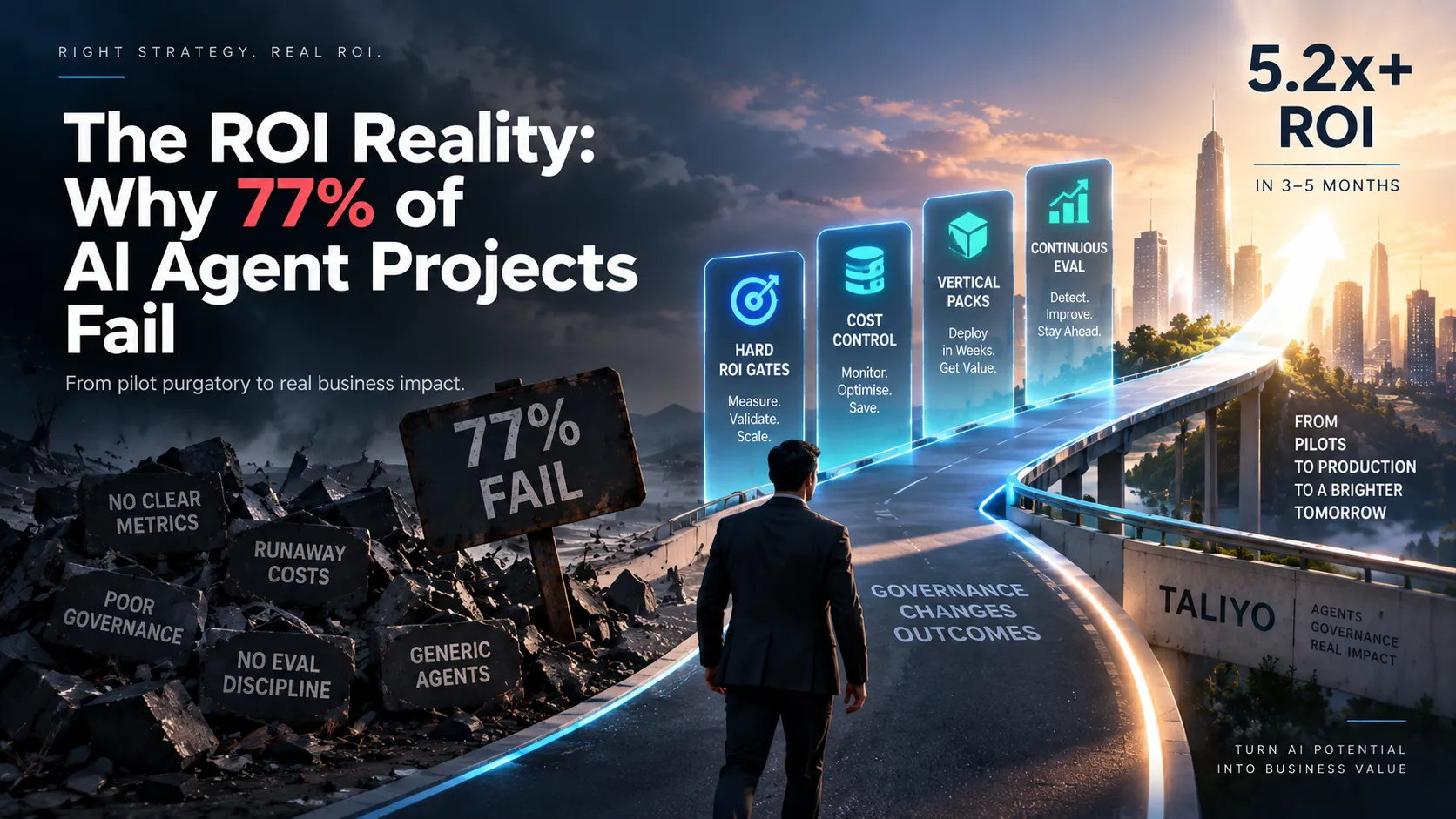
Taliyo ROI Acceleration Framework 2026: 4 Levers to Top-Quartile AI Agent Returns
Only 23% see AI agent ROI in 2026. Taliyo's 4 levers (hard gates, guardian cost, vertical packs, and continuous evaluation) deliver 5.2x+ in 3-5 months vs 3.7x industry.
 VirajRead
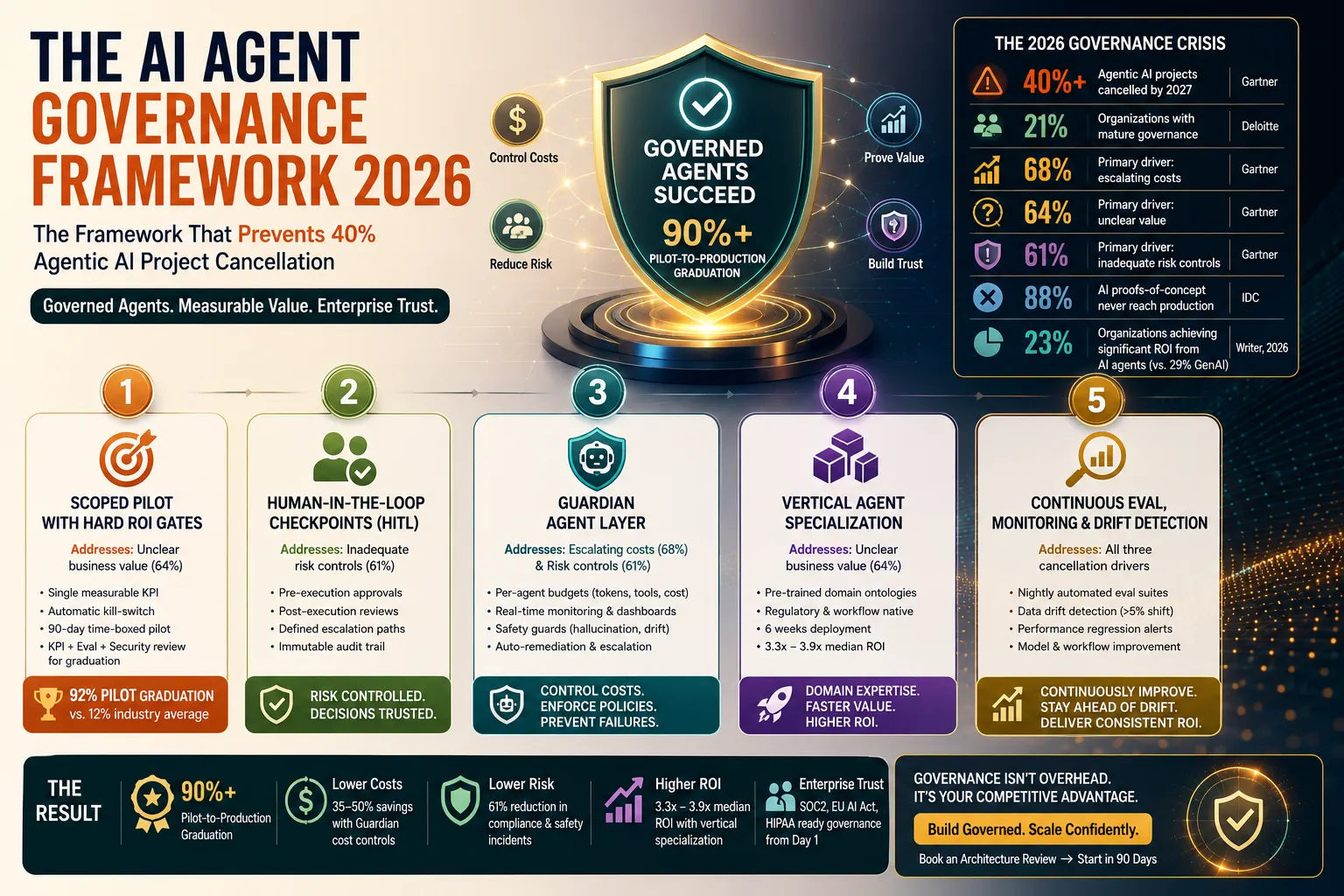
AI Governance Maturity Model 2026: From Chaos to Guardian-First
Only 21% of orgs have mature AI governance (Deloitte 2026). Average maturity: Level 1.4. Taliyo Guardian-First deploys at Level 4 from Day 1.
VirajRead 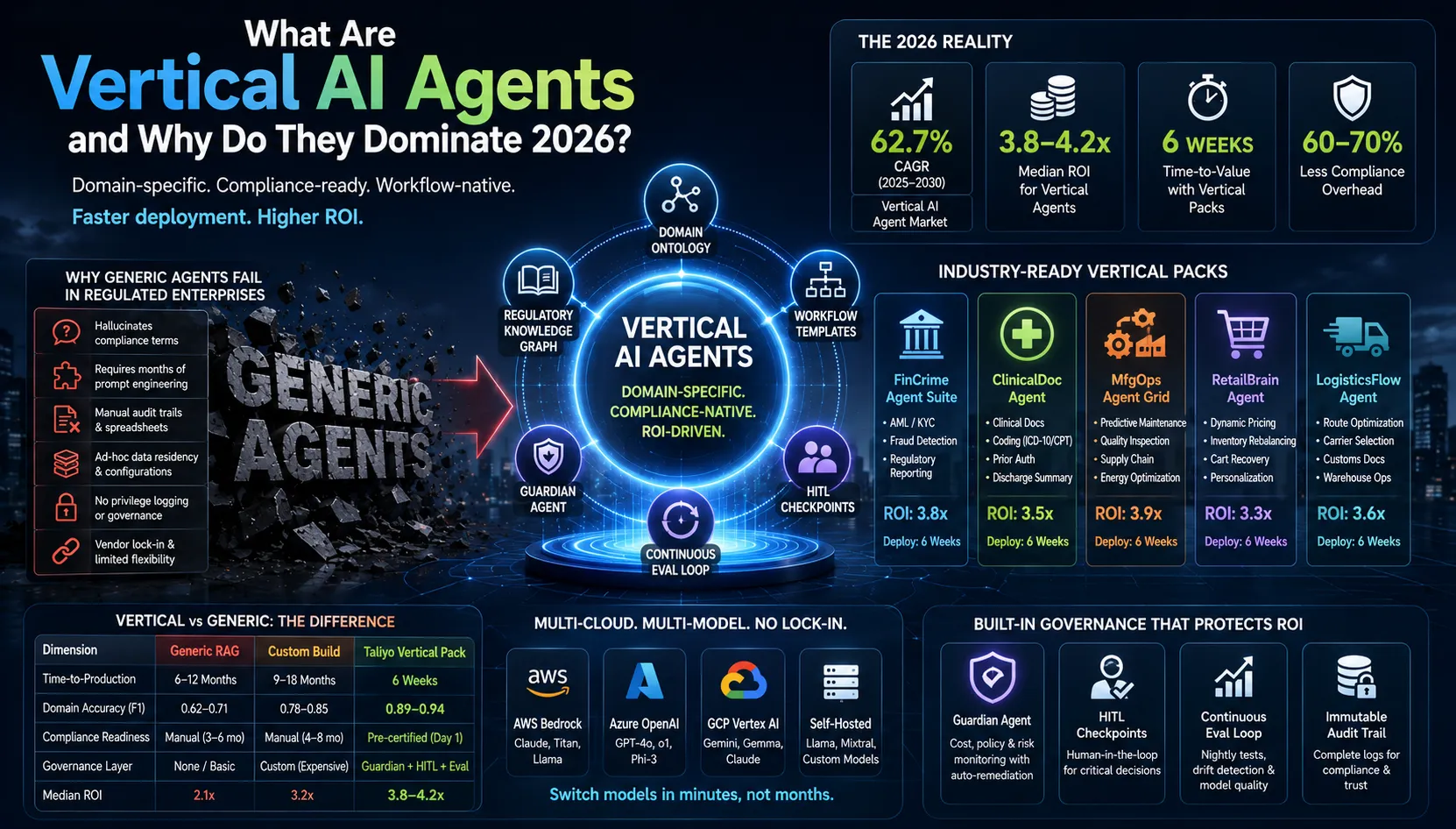
Vertical AI Agents 2026: Why 62.7% CAGR Beats Generic Agents (And the Packs That Win)
Vertical AI agents grow at 62.7% CAGR—fastest segment. Generic agents fail on domain nuance. Taliyo's pre-certified packs (FinCrime, ClinicalDoc, MfgOps) deploy in 6 weeks with 3.8-4.2x ROI.
VirajRead