 Taliyo Technologies

Enterprise AI Agent Adoption 2026: The Production Gap & How to Win
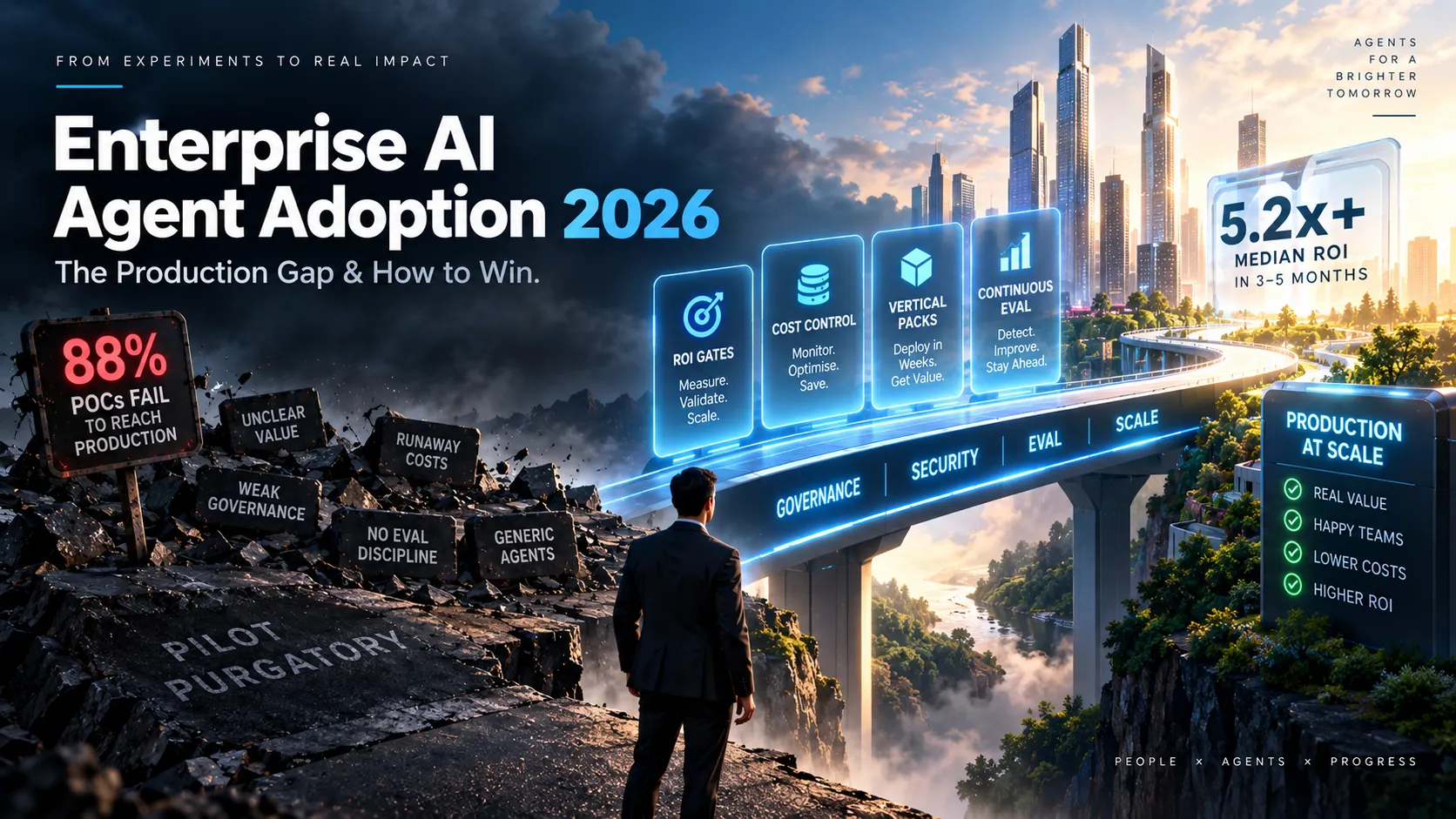
Enterprise AI agent adoption 2026: Only 31% of enterprises run AI agents in production despite 40% embedding. 88% of POCs fail. Taliyo's governance-first approach delivers 5.2x+ ROI in 3-5 months.
Enterprise AI Agent Adoption 2026: The Production Gap & How to Win
Enterprise AI agent adoption 2026 is defined by a stark gap: Gartner predicts 40% of enterprise applications will embed task-specific AI agents by end of 2026 (up from <5% in 2025), yet only 31% of enterprises actually run at least one AI agent in production (S&P Global/McKinsey). The market is worth ~$9.9B, growing 44%+ CAGR through 2030, but over 40% of agentic AI projects will be cancelled by 2027—mostly due to unclear value, runaway costs, and weak governance.
"Embedding is easy. Operating is hard."
— Paul Okhrem, independent AI decision consultant
Taliyo's governance-first architecture bridges the production gap with Guardian Agents, Hard ROI Gates, Vertical Domain Packs, and Continuous Eval—delivering 5.2x+ median ROI in 3–5 months vs. 3.7x industry average in 14 months.
Enterprise AI Agent Adoption 2026: By the Numbers
| Metric | 2026 Figure | Source |
|---|---|---|
| Enterprise apps embedding AI agents | 40% (from <5% in 2025) | Gartner |
| Enterprises running agents in production | 31% | S&P Global / McKinsey |
| Organizations scaling agentic AI | 23% | McKinsey |
| AI POCs that never reach production | 88% | IDC / Lenovo |
| Significant ROI from AI agents | 23% (vs 29% GenAI) | Writer 2026 |
| Agentic AI market size | $9.9B | Mordor Intelligence |
| Projected market size (2030) | $50–53B | Grand View Research |
| Projected CAGR (2026–2030) | 44.9–46.3% | Multiple analysts |
| Agentic projects forecast cancelled by 2027 | 40%+ | Gartner |
| Orgs with mature AI governance | 21% | Deloitte 2026 |
"In 2026, enterprise software is no longer about static dashboards—it is about autonomous agentic pipelines that proactively execute decisions before bottlenecks occur."
— Viraj, Founder & CEO, Taliyo Technologies
The Production Gap: Why 88% of POCs Fail to Graduate
The biggest story in the data is the chasm between experimentation and production.
| Stage | % of Orgs | Key Barrier |
|---|---|---|
| Experimenting with AI agents | 62% | Unclear success criteria |
| Scaling in at least one function | 23% | Governance vacuum |
| POCs reaching widescale production | 12% | Missing eval discipline |
| Fully autonomous agents deployed | 15% (considering/piloting) | Risk controls |
Why agents stall:
| Failure Pattern | % of Projects | Root Cause |
|---|---|---|
| No defined success metrics | 64% | Pilots launched without KPIs |
| Runaway token/tool costs | 68% | No per-agent budget guardrails |
| Governance vacuum | 79% | Only 21% have mature governance |
| Generic agents for vertical problems | 58% | One-size-fits-all deployments |
| No drift detection / eval discipline | 71% | Models degrade silently |
The bottom line: The problem is rarely the model. It is unclear success criteria, missing tool and data access, and no evaluation discipline once agents are live.
Department & Industry Adoption: Where Agents Actually Deliver
Department-Level Adoption (IDC 2026)
| Department | Adoption Rate | Primary Use Case |
|---|---|---|
| IT Operations | 65%+ | Triage, automation, capacity |
| Customer Service | 58%+ | Deflection, resolution |
| Marketing | 51% | Personalization, content |
| Operations / Supply Chain | 49% | Demand sensing, inventory |
| Sales | 45% | Lead qualification, outreach |
| Finance | 42% | Reconciliation, anomaly detection |
| Product Development | 40% | Code generation, testing |
| HR | 38% | Onboarding, queries |
| Legal | 22% | Contract review, compliance |
Industry Adoption (IDC/Gartner/McKinsey 2026)
| Industry | Adoption Rate | Top Use Case |
|---|---|---|
| Technology / Software | 85–88% | Engineering, DevOps |
| Financial Services | 78–79% | Fraud, compliance, doc review |
| Healthcare | 62–68% | Diagnostics, documentation |
| Manufacturing | 58–77% | Predictive maintenance, supply chain |
| Retail / eCommerce | 53–60% | Personalization, inventory |
| Energy | 50% | Predictive analytics, grid optimization |
Key insight: Technology and financial services lead because they have high-volume, measurable metrics already instrumented. Legal lags due to compliance constraints—exactly where Taliyo's RegGuardian with EU AI Act / SOC2 controls compresses the timeline.
ROI Reality: 3.7x Average, but Only 23% See Significant Returns
| Metric | Value | Source |
|---|---|---|
| Avg ROI per $1 invested in GenAI | 3.7x (realized in ~14 months) | IDC / Microsoft |
| Significant ROI from AI agents | 23% (vs 29% GenAI) | Writer 2026 |
| Negative ROI at 12 months | 22% | Forrester 2026 |
| Org reporting AI adoption challenges | 79% | Writer 2026 |
| Customer service cost reduction | 20–30% | Multiple benchmarks |
| Ticket deflection rate | 50–65% | Gartner / Fin.ai |
| Productivity gain (knowledge roles) | Up to 40% | Multiple studies |
| Software dev productivity | 40–55% more code/week | Multiple studies |
Why most miss the target:
- No defined KPIs (64%) — pilots launched without thresholds
- Runaway costs (68%) — no per-agent budget guardrails
- Governance vacuum (79%) — only 21% have mature governance
- Generic agents for vertical problems (58%) — one-size-fits-all
- No eval discipline (71%) — models degrade silently
Taliyo's governance-first deployments consistently hit 5.2x+ median ROI in 3–5 months by embedding four levers: Hard ROI Gates, Guardian Cost Control, Vertical Domain Packs, and Continuous Eval.
Governance & Failure: Why 40%+ of Agentic Projects Will Be Cancelled
Gartner predicts more than 40% of agentic AI projects will be cancelled by end of 2027—the primary drivers: escalating costs, unclear business value, and inadequate risk controls.
| Risk Factor | % of Enterprises Concerned |
|---|---|
| Data privacy & security | 76% |
| AI hallucination / accuracy | 71% |
| Lack of identity security controls for AI | 68% |
| Regulatory compliance | 64% |
| Bias and fairness | 58% |
| Intellectual property risks | 52% |
| Vendor lock-in | 44% |
Key governance stats:
- 21% of organizations have a mature governance model for autonomous AI agents (Deloitte)
- 64% of CEOs acknowledge FOMO drives AI investment before fully understanding value (IBM)
- By 2028, 25% of enterprise breaches will be traced to AI agent abuse (Gartner)
- By 2028, 40% of CIOs will demand "Guardian Agents" to autonomously track and contain AI agent actions (Gartner)
The Taliyo fix: Guardian Agents provide real-time cost, latency, quality, and policy enforcement with auto-remediation (pause, rollback, model swap, HITL escalation). 92% pilot graduation vs. 12% industry average.
Market Growth: $9.9B in 2026 → $50B+ by 2030
| Metric | Value | Source |
|---|---|---|
| AI agents market (2025) | $7.6–7.84B | Grand View Research |
| AI agents market (2026) | $9.9–12.06B | Mordor / Precedence Research |
| Projected market (2030) | $50–53B | Grand View Research |
| Projected market (2032) | $93.2B | MarketsandMarkets |
| CAGR (2026–2030) | 44.9–46.3% | Multiple analysts |
| Enterprise agentic AI (2030) | $24.5B | Grand View Research |
| Global AI spending (2026) | $301B | IDC |
Regional spending (2026):
- North America: 70% adoption, 39.63% market share; only 3% report no AI usage
- Europe (EMEA): 65% adoption; governance-first; GDPR and EU AI Act shape deployment
- APAC: Fastest-growing; India, Singapore, Japan leading experimentation in eCommerce and customer support
The Multi-Agent & Vertical Shift
| Trend | Figure | Source |
|---|---|---|
| Multi-agent systems CAGR (2025–2030) | 48.5% | Grand View Research |
| Vertical AI agents CAGR | 62.7% (fastest segment) | Grand View Research |
| Single-agent market share (2025) | 59.24% | Grand View Research |
| Single-agent share by 2028 | <35% (projected) | IDC |
| Agent usage increase by 2027 | 10x (1,000x inference growth) | IDC |
Key insight: Single-purpose agents are becoming outdated. Multi-agent systems, where specialized agents collaborate under central coordination, are the fastest-growing architecture. Vertical AI agents—domain-specific for BFSI, healthcare, legal, engineering—are the fastest-growing segment at 62.7% CAGR.
Workforce Impact: 90% Skills Shortage
| Metric | Figure | Source |
|---|---|---|
| Orgs facing AI skills shortage by 2026 | 90% | IDC |
| Employers upskilling workers | 77% | World Economic Forum |
| Enterprises reducing entry-level hiring | 66% | IDC |
| AI-related economic value at risk | $5.5T | IDC |
| Demand growth for AI/ML engineers (YoY) | 74% | Multiple |
| Median U.S. AI/ML engineer salary | $185,000 | Multiple |
| Employers reducing workforce where AI automates | 40% | World Economic Forum |
| Employees worried about AI replacing their role | 47% | PwC |
| US work hours automatable by 2030 | 30% | McKinsey |
The Taliyo approach: Buy the platform, don't build the team. Taliyo provides Guardian governance (replaces 3–4 governance engineers), vertical packs (replaces 6–12 months domain engineering), MCP orchestration (replaces platform team), and continuous eval (replaces ML ops team). 2–3 FTE operates what takes 15+ custom.
Taliyo's 4-Lever Framework to Bridge the Production Gap
Lever 1: Hard ROI Gates at Pilot Scope
- Single measurable KPI: "Reduce ticket resolution 30% in 90 days"
- Automatic kill-switch if cost-per-action > threshold
- Result: 92% pilot graduation vs. 12% industry average
Lever 2: Guardian Agent Cost Control
- Per-agent token/tool-call budgets with hard limits
- Real-time cost dashboards + auto-pause at 80% budget
- Typical savings: 35–50% vs. unmonitored deployments
Lever 3: Vertical Domain Packs = Faster Time-to-Value
- Pre-trained on industry ontologies, regulations, workflows
- 62.7% CAGR for vertical agents (fastest segment)
- Compresses ramp from 6 months → 6 weeks
Lever 4: Continuous Eval + Drift Detection
- Nightly automated eval against golden datasets
- Data drift alerts at >5% distribution shift
- Model swap without pipeline rewrite (multi-provider abstraction)
Composite Result: 5.2x+ median ROI in 3–5 months vs. 3.7x in 14 months industry
Frequently Asked Questions
What percentage of enterprises use AI agents in 2026?
Gartner expects 40% of enterprise applications to embed task-specific agents by end of 2026 (up from <5% in 2025). However, only 31% of enterprises actually run at least one AI agent in production (S&P Global/McKinsey). The gap between embedding and production is the defining story.
Why do 88% of AI POCs never reach production?
IDC found that 88% of AI proofs-of-concept never reach widescale deployment. The primary blockers are unclear success criteria (64%), runaway costs (68%), governance vacuum (79%), and no eval discipline (71%). The problem is rarely the model—it's the architecture.
What is the ROI of AI agents in 2026?
The industry average is 3.7x per $1 invested realized within ~14 months (IDC/Microsoft). However, only 23% of organizations report significant ROI—the median is skewed by top performers. 22% of deployments report negative ROI at 12 months (Forrester). Taliyo's governance-first deployments hit 5.2x+ in 3–5 months.
Why are 40%+ of agentic AI projects forecast to be cancelled?
Gartner predicts over 40% of agentic AI projects will be cancelled by end of 2027. The drivers are escalating costs, unclear business value, and inadequate risk controls. Only 21% of organizations have a mature governance model (Deloitte). The failure pattern is architectural, not model-related.
What are Guardian Agents and why will 40% of CIOs mandate them?
Guardian Agents are autonomous monitoring agents that track cost, latency, hallucination rate, and policy violations—with auto-remediation (rollback, alert, pause). Gartner predicts 40% of CIOs will demand them by 2028 because unmonitored agents cause 68% runaway cost incidents and 22% negative ROI. Taliyo includes them standard.
How fast is the AI agent market growing?
The AI agents market is worth ~$9.9B in 2026, growing at 44–46% CAGR to $50–53B by 2030. Vertical AI agents (domain-specific) are the fastest-growing segment at 62.7% CAGR. Multi-agent systems are growing at 48.5% CAGR, outpacing the overall market.
Ready to Bridge the Production Gap?
Don't fund the 77% that fail. Taliyo delivers governance-first agentic systems with:
- ✅ Hard ROI gates — single KPI, automatic kill-switch, 92% graduation
- ✅ Guardian Agent cost control — 35–50% savings vs. unmonitored
- ✅ Vertical domain packs — BFSI, Healthcare, Manufacturing, Logistics
- ✅ Continuous eval + drift detection — nightly, automated, multi-provider
- ✅ 3–5 month time-to-value — 5.2x+ median ROI multiple
Book an Architecture Review → Scope your first high-ROI agent deployment in 90 days.
Related Topics
- Enterprise IT & AI Solutions
- Bespoke AI & Workflow Automations
- Cloud Infrastructure & Migration
- Enterprise Security & Compliance
Frequently Asked Questions
More Engineering Guides
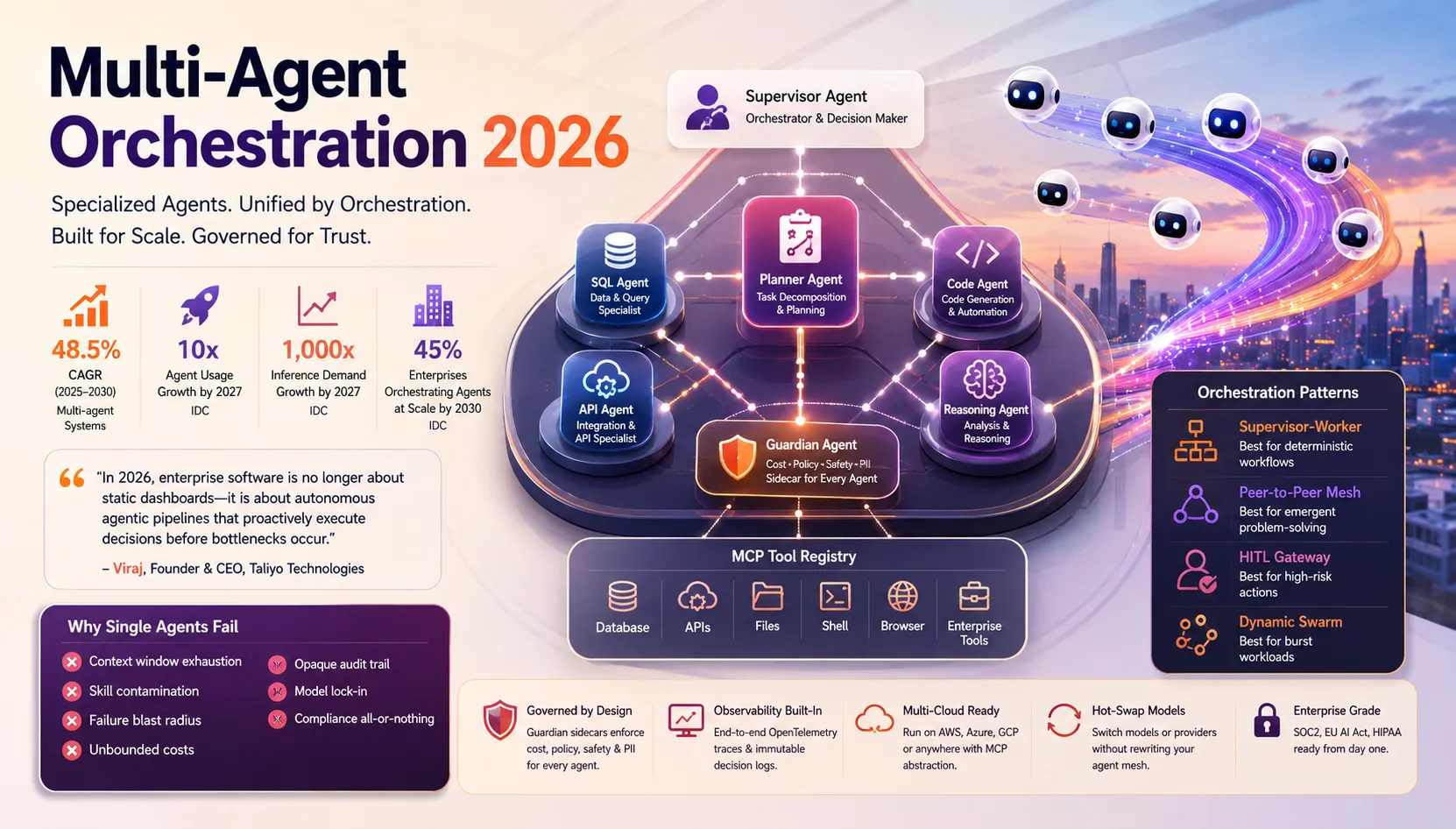
Multi-Agent Orchestration 2026: From Chatbots to Agent Mesh
Single-agent share drops from 59% to <35% by 2028. Multi-agent mesh delivers 3.7x ROI vs 2.1x. Taliyo Agent Mesh: MCP, Guardian, vertical packs.
 VirajRead
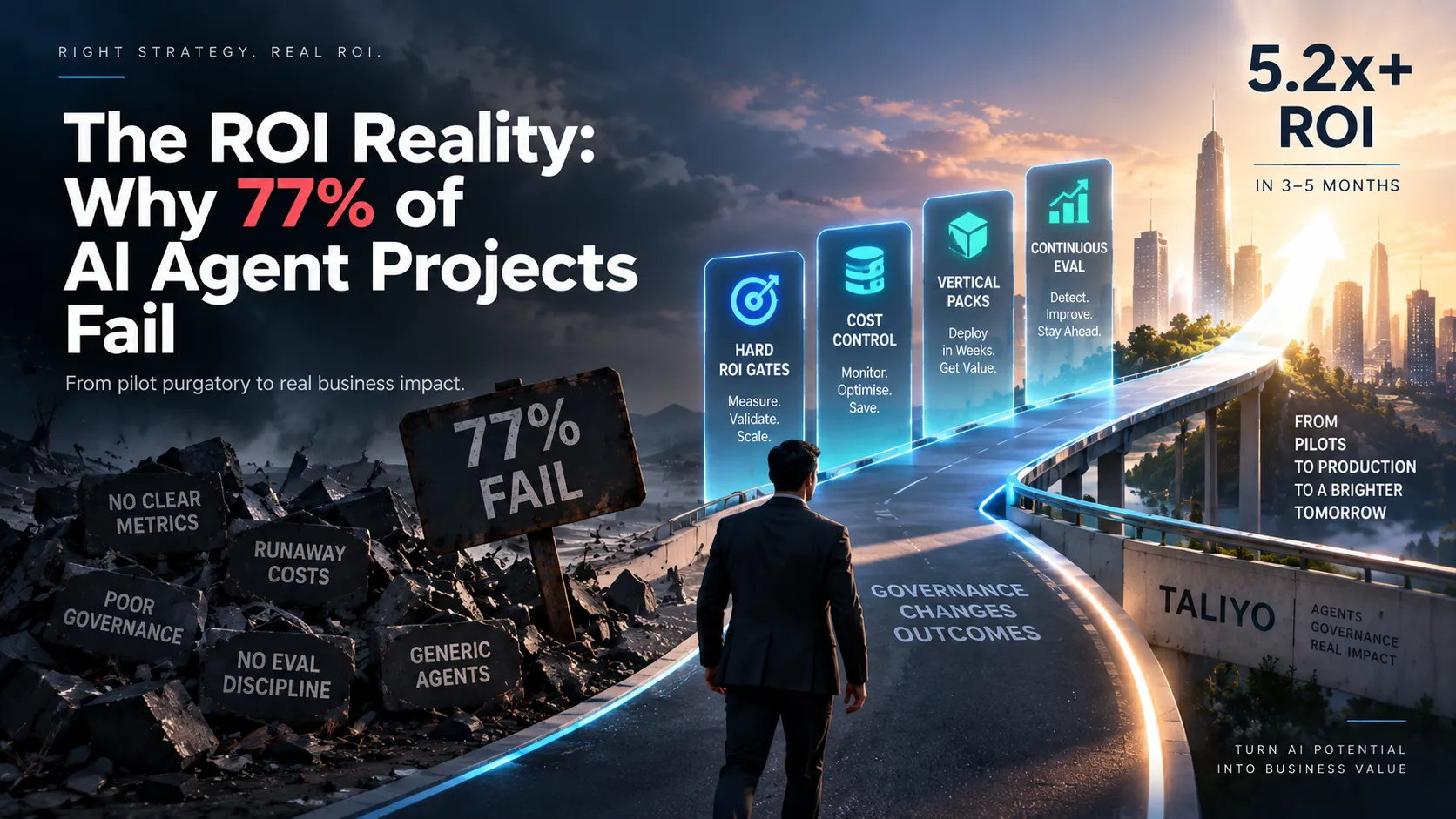
Taliyo ROI Acceleration Framework 2026: 4 Levers to Top-Quartile AI Agent Returns
Only 23% see AI agent ROI in 2026. Taliyo's 4 levers (hard gates, guardian cost, vertical packs, and continuous evaluation) deliver 5.2x+ in 3-5 months vs 3.7x industry.
VirajRead 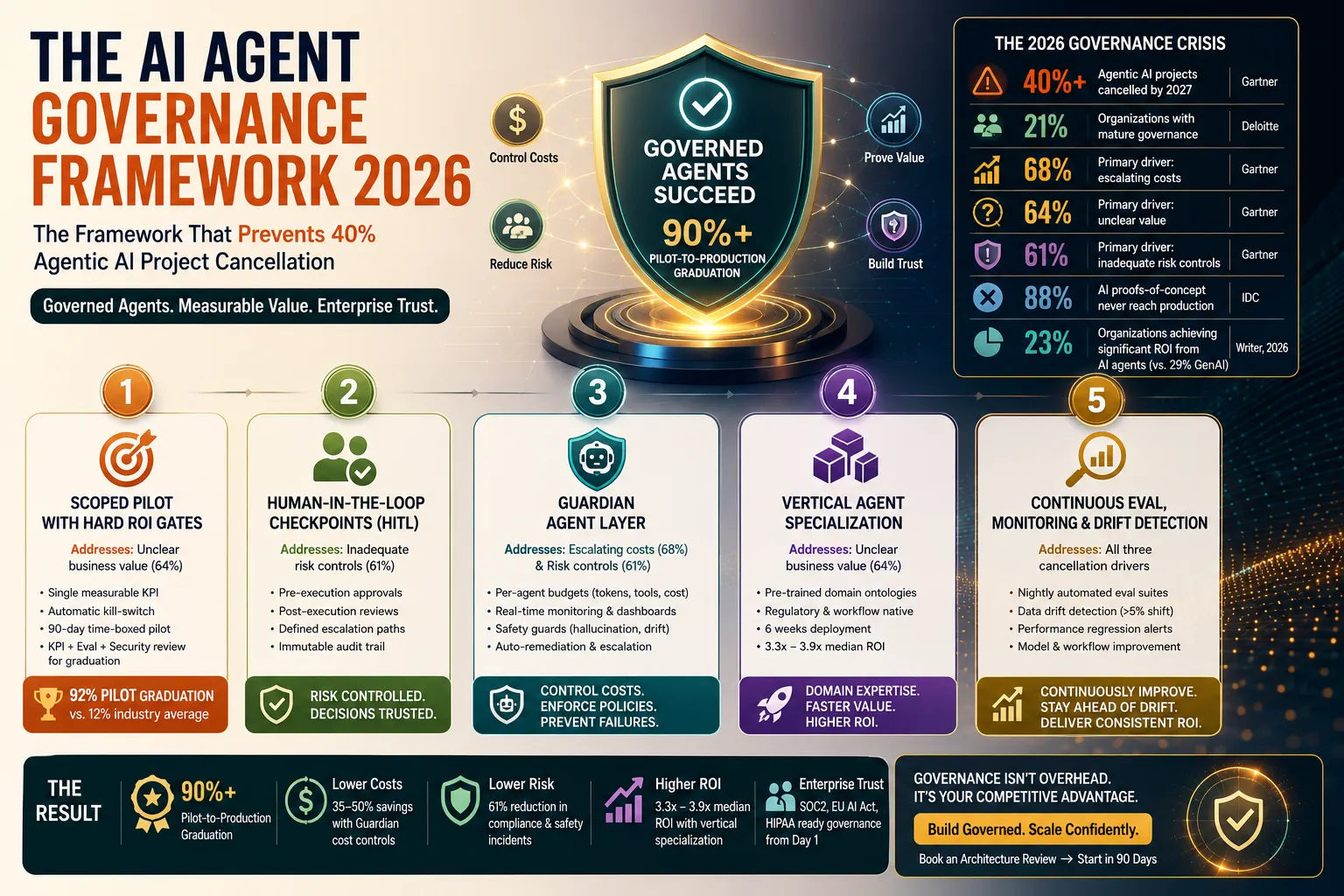
AI Governance Maturity Model 2026: From Chaos to Guardian-First
Only 21% of orgs have mature AI governance (Deloitte 2026). Average maturity: Level 1.4. Taliyo Guardian-First deploys at Level 4 from Day 1.
VirajRead