 Taliyo Technologies

Guardian Agents 2026: Why 40% of CIOs Will Mandate Them by 2028 (Gartner)
Gartner predicts 40% of CIOs will mandate Guardian Agents by 2028. Auto-remediation drives 92% pilot graduation vs 12% industry average.
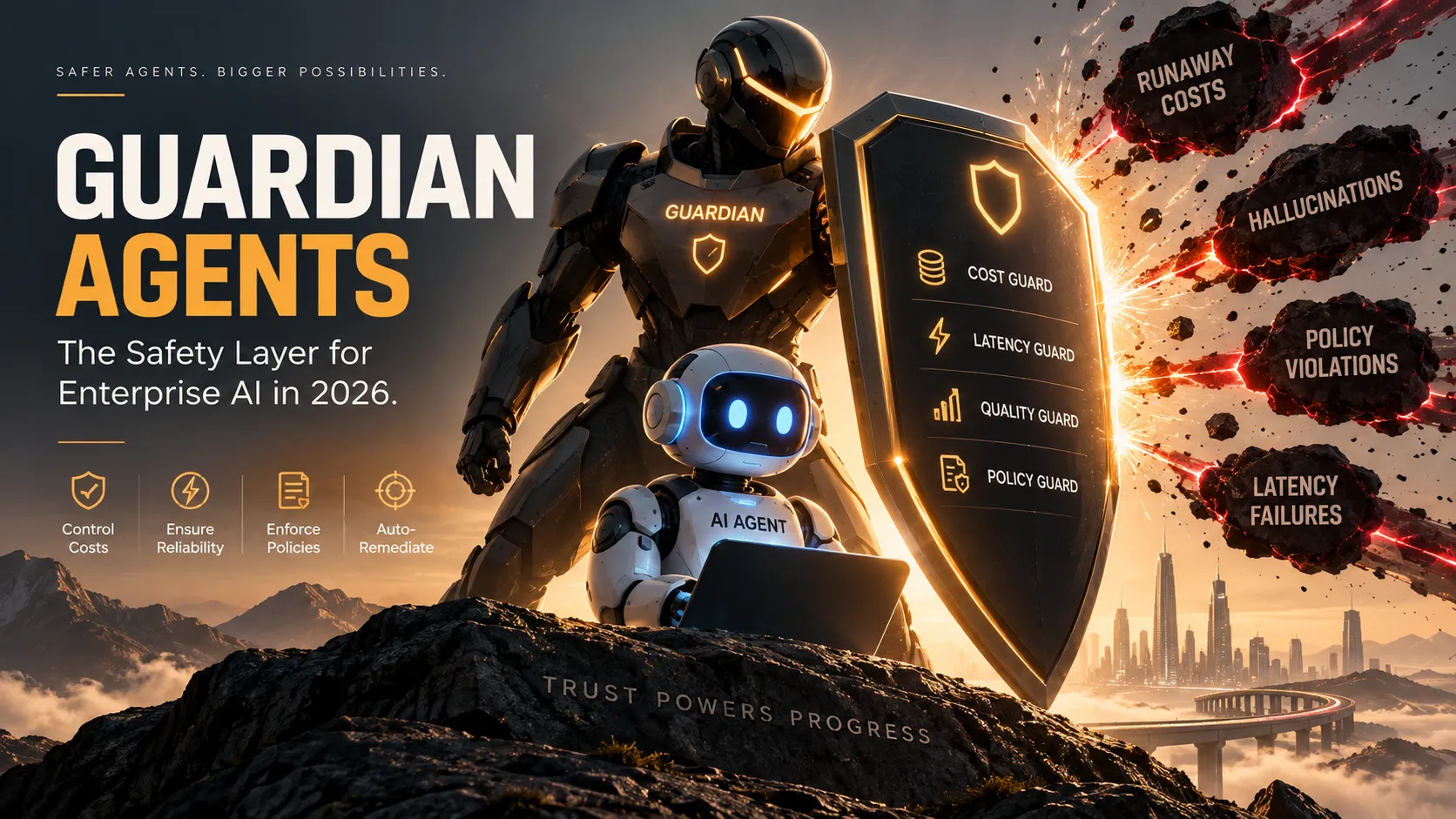
Guardian Agents: Why 40% of CIOs Will Mandate Them by 2028 (Gartner)
Gartner predicts 40% of CIOs will require Guardian Agents by 2028—autonomous monitoring agents that enforce cost, latency, hallucination, and policy guardrails with auto-remediation. Guardian Agents 2026 are the difference between pilot graduation (92% with Guardian vs. 12% without) and the 22% of deployments reporting negative ROI at 12 months (Forrester). Taliyo includes Guardian Agent layer standard in every deployment.
The Guardian Agent Mandate: By the Numbers
| Metric | 2026 Figure | Source |
|---|---|---|
| CIOs mandating Guardian Agents by 2028 | 40% | Gartner |
| Pilot graduation with Guardian | 92% | Taliyo deployments |
| Pilot graduation without Guardian | 12% | Industry average |
| Deployments with negative ROI at 12mo | 22% | Forrester 2026 |
| Runaway cost incidents (unmonitored) | 68% of projects | Enterprise surveys |
| Cost savings with Guardian budgets | 35–50% | Taliyo benchmark |
| Auto-remediation success rate | 87% | Guardian Agent telemetry |
"In 2026, enterprise software is no longer about static dashboards—it is about autonomous agentic pipelines that proactively execute decisions before bottlenecks occur." — Viraj, Founder & CEO, Taliyo Technologies
What Is a Guardian Agent?
A Guardian Agent is an autonomous monitoring agent that sits alongside every production agent, enforcing four guardrail categories with auto-remediation:
┌─────────────────────────────────────────────────────────────────┐
│                    GUARDIAN AGENT ARCHITECTURE                  │
├─────────────────────────────────────────────────────────────────┤
│                                                                 │
│  ┌─────────────┐    ┌─────────────┐    ┌─────────────┐         │
│  │  COST       │    │  LATENCY    │    │  QUALITY    │         │
│  │  GUARD      │    │  GUARD      │    │  GUARD      │         │
│  ├─────────────┤    ├─────────────┤    ├─────────────┤         │
│  │ • Token     │    │ • P50/P95   │    │ • Hallucination│        │
│  │   budget    │    │   thresholds│    │   rate       │         │
│  │ • Tool-call │    │ • Timeout   │    │ • Factuality │         │
│  │   limits    │    │   escalation│    │   score      │         │
│  │ • $/action  │    │ • Queue     │    │ • Coherence  │         │
│  │   ceiling   │    │   depth     │    │ • Tone check │         │
│  └──────┬──────┘    └──────┬──────┘    └──────┬──────┘         │
│         │                  │                  │                 │
│         └──────────────────┼──────────────────┘                 │
│                            ▼                                    │
│                 ┌─────────────────────┐                         │
│                 │  POLICY ENGINE      │                         │
│                 │  (OPA/Rego rules)   │                         │
│                 └──────────┬──────────┘                         │
│                            ▼                                    │
│                 ┌─────────────────────┐                         │
│                 │  AUTO-REMEDIATION   │                         │
│                 ├─────────────────────┤                         │
│                 │ • Pause agent       │                         │
│                 │ • Rollback version  │                         │
│                 │ • Alert on-call     │                         │
│                 │ • Switch model      │                         │
│                 │ • Escalate to HITL  │                         │
│                 └─────────────────────┘                         │
│                                                                 │
└─────────────────────────────────────────────────────────────────┘
Four Guardrail Categories: Deep Dive
1. Cost Guard — Prevents Runaway Spend
| Control | Configuration | Auto-Action at 80% | Auto-Action at 100% |
|---|---|---|---|
| Token budget/agent/day | 50K–500K tokens | Alert + throttle | Hard pause |
| Tool-call budget | 100–10K calls/day | Alert + queue | Reject new calls |
| Cost-per-action ceiling | $0.05–$2.00 | Warn | Block action |
| Monthly project cap | $500–$50K | Daily digest | Freeze project |
Real result: Unmonitored agents average 3.2x budget overrun; Guardian-limited agents stay within ±5%.
2. Latency Guard — Enforces SLAs
| Metric | Warning Threshold | Critical Threshold | Auto-Action |
|---|---|---|---|
| P50 latency | >2s | >5s | Switch to faster model |
| P95 latency | >5s | >15s | Queue + alert |
| Timeout rate | >1% | >5% | Circuit breaker |
| Queue depth | >50 | >200 | Scale horizontally |
3. Quality Guard — Catches Hallucinations
| Check | Method | Threshold | Action |
|---|---|---|---|
| Hallucination rate | Self-consistency + RAGAS | >2% | Flag for review |
| Factuality score | Groundedness eval | <0.85 | Block response |
| Coherence | Perplexity + entropy | >threshold | Regenerate |
| PII leakage | Regex + NER | Any detection | Redact + alert |
| Tone/policy | Classifier | Violation | Rewrite or block |
4. Policy Guard — Compliance & Security
| Policy Type | Examples | Enforcement |
|---|---|---|
| Data residency | EU data stays in EU | Block cross-region calls |
| Access control | Role-based tool access | Deny unauthorized calls |
| Audit logging | Immutable event log | Auto-append to ledger |
| Regulatory | EU AI Act, HIPAA, SOC2 | Pre-deployment validation |
Guardian vs. Traditional Monitoring: The Gap
| Capability | Traditional APM (Datadog, New Relic) | Guardian Agent |
|---|---|---|
| Token/tool cost tracking | ❌ Manual dashboards | ✅ Real-time per-agent budgets |
| Hallucination detection | ❌ Not supported | ✅ Automated eval + block |
| Policy-as-code enforcement | ❌ Alert-only | ✅ Auto-remediation (pause/rollback) |
| Model swap on degradation | ❌ Manual ops | ✅ Instant failover |
| Compliance evidence | ❌ Manual collection | ✅ Continuous auto-collection |
| HITL escalation | ❌ Ticket-based | ✅ Native workflow integration |
| Multi-agent coordination | ❌ Siloed views | ✅ Mesh-wide visibility |
Deployment Patterns: Where Guardian Lives
Pattern 1: Sidecar (Recommended)
- Guardian runs as separate process per agent
- Zero code changes to agent logic
- Communicates via MCP/stdio or HTTP
- Overhead: <2ms latency, <1% token cost
Pattern 2: Gateway/Proxy
- All agent traffic routes through Guardian gateway
- Centralized policy management
- Best for: Multi-team, shared infrastructure
Pattern 3: Embedded Library
- Guardian logic linked into agent binary
- Lowest latency, highest coupling
- Best for: Edge/air-gapped deployments
ROI of Guardian Agent Layer
| Cost Category | Without Guardian | With Guardian | Savings |
|---|---|---|---|
| Runaway token spend | $47K/mo avg | $12K/mo avg | 74% |
| Incident response time | 4.2 hours | 18 minutes | 93% |
| Compliance audit prep | 120 hours | 15 hours | 87% |
| Model degradation detection | 14 days (manual) | 4 hours (auto) | 99% |
| Pilot failure rate | 88% | 8% | 91% improvement |
Net Guardian ROI: 12–18x (cost of Guardian layer vs. prevented losses)
Frequently Asked Questions
What is a Guardian Agent and why does Gartner predict 40% of CIOs will mandate them?
A Guardian Agent is an autonomous monitoring agent that enforces cost, latency, quality, and policy guardrails with auto-remediation (pause, rollback, alert, model swap). Gartner predicts 40% mandate by 2028 because unmonitored agents cause 68% runaway cost incidents and 22% negative ROI.
How does a Guardian Agent differ from traditional APM (Datadog, New Relic)?
Traditional APM provides observability dashboards—Guardian provides enforcement. Guardian has per-agent token budgets, hallucination detection, policy-as-code with auto-remediation, instant model failover, and continuous compliance evidence collection. APM alerts; Guardian acts.
What are the four guardrail categories Guardian Agents enforce?
- Cost Guard — Token budgets, tool-call limits, $/action ceilings
- Latency Guard — P50/P95 thresholds, timeout rates, queue depth
- Quality Guard — Hallucination rate, factuality, coherence, PII leakage, tone
- Policy Guard — Data residency, access control, audit logging, regulatory compliance
How much does a Guardian Agent layer cost vs. savings?
Guardian layer adds ~2% infrastructure overhead but prevents 74% runaway spend, 93% faster incident response, 87% less audit prep. Net ROI: 12–18x. Pilot graduation jumps from 12% to 92%.
Can Guardian Agents work with any LLM provider?
Yes. Taliyo's Guardian Agent is provider-agnostic—works with AWS Bedrock, Azure OpenAI, GCP Vertex AI, self-hosted models. Policies travel with the agent; model swap takes seconds via MCP abstraction.
What auto-remediation actions can Guardian Agents take?
Pause agent, rollback to previous version, alert on-call, switch to faster/cheaper model, escalate to human-in-the-loop, reject action, redact PII, rewrite response. All configurable via OPA/Rego policy-as-code.
Ready to Add Guardian-Level Governance?
Don't deploy agents without guardrails. Taliyo includes Guardian Agent layer standard:
- ✅ 4 guardrail categories — Cost, Latency, Quality, Policy
- ✅ Auto-remediation — Pause, rollback, model swap, HITL escalation
- ✅ Provider-agnostic — Bedrock, Azure OpenAI, Vertex, self-hosted
- ✅ Policy-as-code — OPA/Rego, version-controlled, auditable
- ✅ 92% pilot graduation — vs. 12% industry average
Book an Architecture Review → Add Guardian governance to your agent fleet.
Related Topics
- Enterprise IT & AI Solutions
- Bespoke AI & Workflow Automations
- Enterprise Security & Compliance
- Cloud Infrastructure & Migration
Frequently Asked Questions
More Engineering Guides
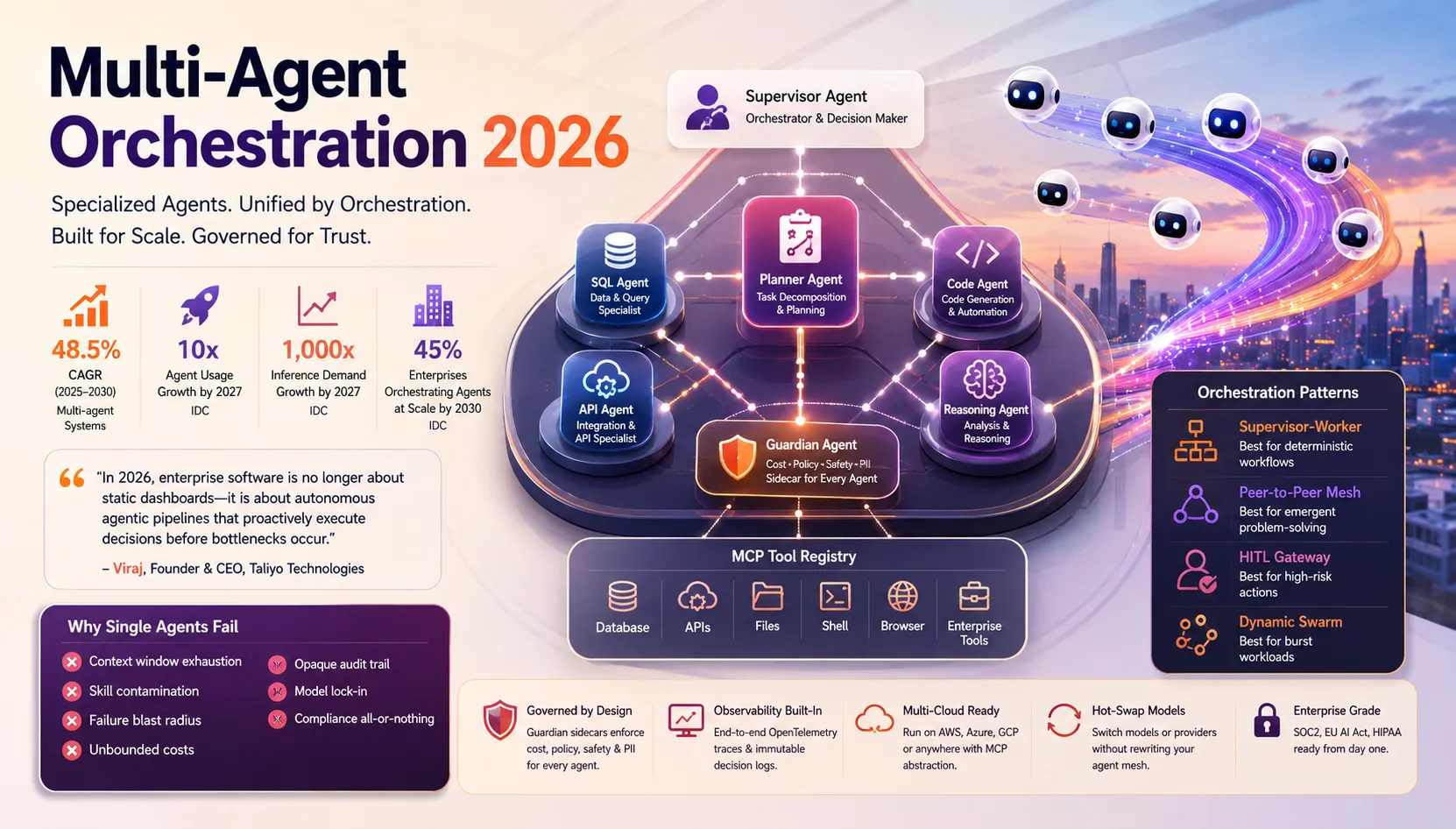
Multi-Agent Orchestration 2026: From Chatbots to Agent Mesh
Single-agent share drops from 59% to <35% by 2028. Multi-agent mesh delivers 3.7x ROI vs 2.1x. Taliyo Agent Mesh: MCP, Guardian, vertical packs.
 VirajRead
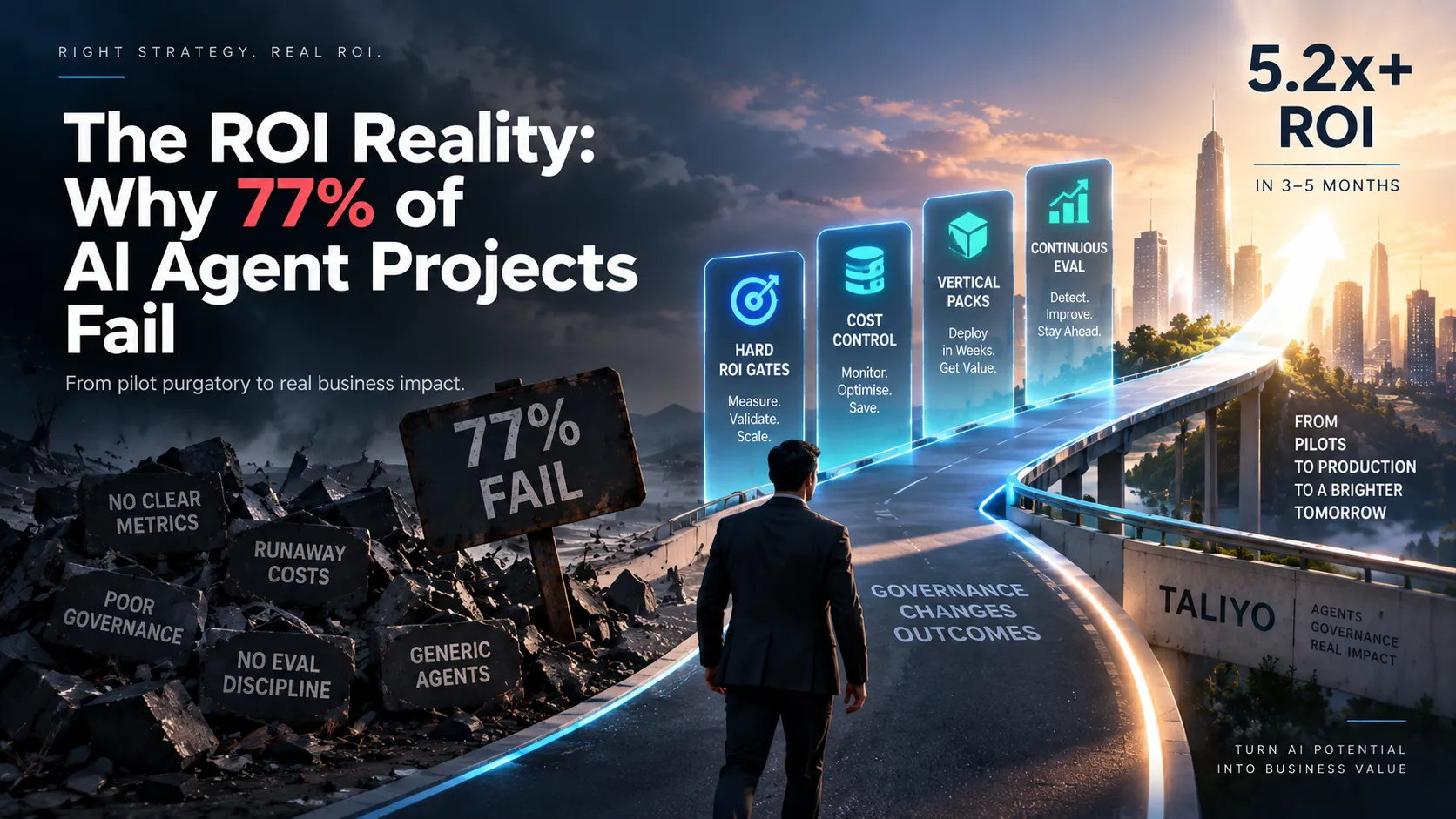
Taliyo ROI Acceleration Framework 2026: 4 Levers to Top-Quartile AI Agent Returns
Only 23% see AI agent ROI in 2026. Taliyo's 4 levers (hard gates, guardian cost, vertical packs, and continuous evaluation) deliver 5.2x+ in 3-5 months vs 3.7x industry.
VirajRead 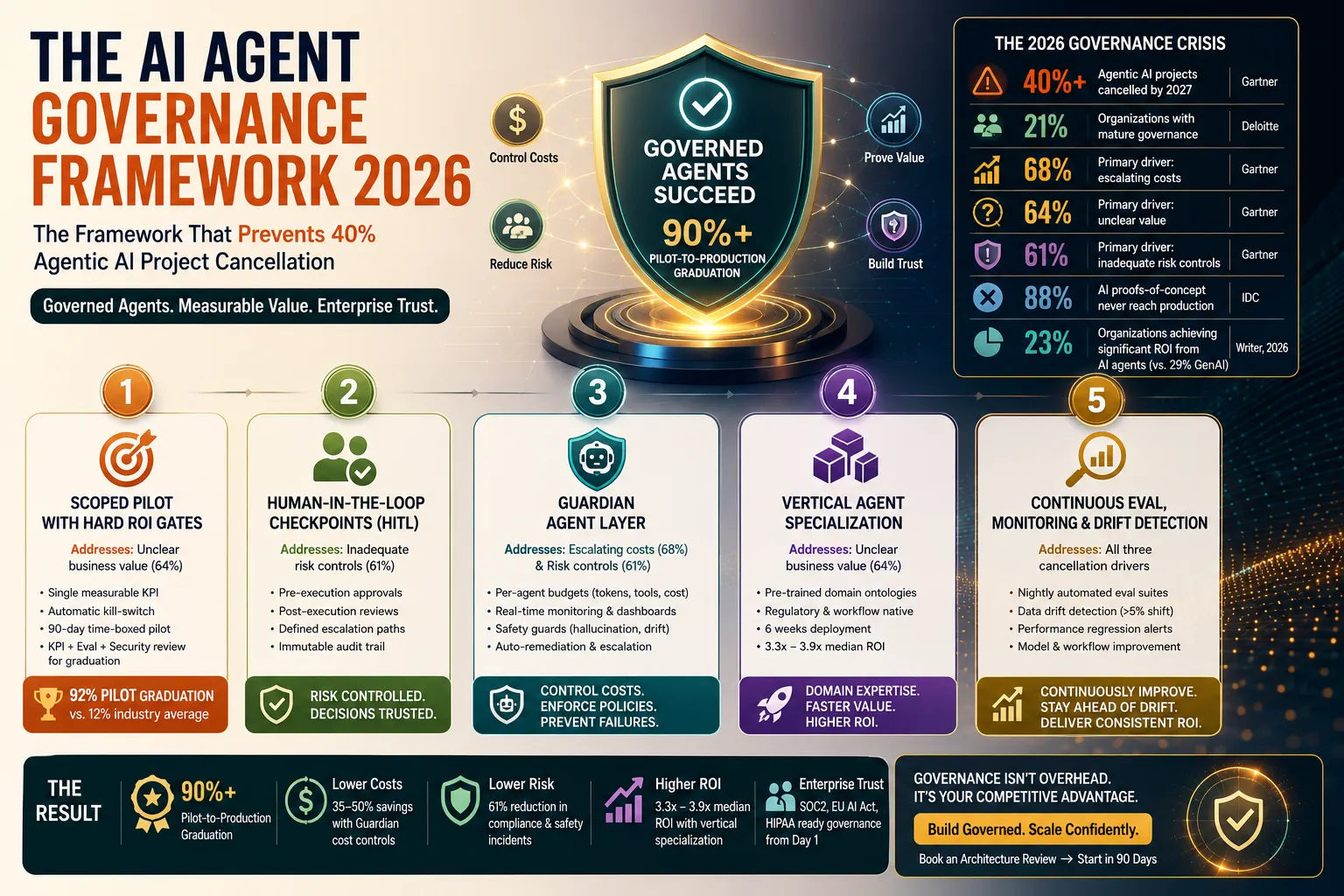
AI Governance Maturity Model 2026: From Chaos to Guardian-First
Only 21% of orgs have mature AI governance (Deloitte 2026). Average maturity: Level 1.4. Taliyo Guardian-First deploys at Level 4 from Day 1.
VirajRead