 Taliyo Technologies

Human-in-the-Loop Design Patterns 2026: The 87% Graduation Secret
Pilot graduation jumps from 12% to 87% with structured HITL. 6 patterns ranked by ROI. Guardian + HITL = 3x faster autonomy graduation.

Human-in-the-Loop Design Patterns 2026: The 87% Graduation Secret
Pilot graduation jumps from 12% to 87% when HITL checkpoints are embedded from Day 1 (Taliyo data vs. industry average). Human-in-the-loop design patterns 2026 aren't about slowing down agents—they're about accelerating trust so agents can operate autonomously at scale. The 23% of orgs seeing significant ROI (Writer 2026) all have structured HITL; the 77% that don't, stall in pilot purgatory.
HITL Impact: By the Numbers
| Metric | Without HITL | With Structured HITL | Source |
|---|---|---|---|
| Pilot graduation rate | 12% | 87% | Taliyo vs. industry |
| Time-to-production | 12–18 months | 3–5 months | Taliyo benchmark |
| Hallucination incidents in prod | 15–22% of sessions | <0.5% | Guardian + HITL telemetry |
| Regulatory findings | 3.2 per audit | 0.1 per audit | Compliance auto-evidence |
| Stakeholder trust score | 3.1/10 | 8.4/10 | Internal surveys |
| Agent autonomy level (6mo) | Level 1 (supervised) | Level 3 (managed) | Autonomy maturity model |
"In 2026, enterprise software is no longer about static dashboards—it is about autonomous agentic pipelines that proactively execute decisions before bottlenecks occur." — Viraj, Founder & CEO, Taliyo Technologies
The Autonomy Maturity Model: Where HITL Fits
| Level | Name | Human Role | Agent Autonomy | Typical Timeline |
|---|---|---|---|---|
| 0 | Manual | Human does everything | 0% | Baseline |
| 1 | Assisted | Human initiates, reviews every output | 10–20% | Pilot start |
| 2 | Supervised | Human approves high-risk actions only | 40–60% | Month 1–2 |
| 3 | Managed | Human sets policy, reviews exceptions | 70–85% | Month 3–4 |
| 4 | Autonomous | Human audits outcomes, updates policy | 90–95% | Month 6+ |
| 5 | Self-Governing | Human defines intent; agent self-corrects | 99%+ | Year 2+ |
Key insight: HITL is not binary. It's a progressive reduction of human touchpoints as trust metrics improve. Taliyo's Guardian Agent automates this progression.
6 HITL Design Patterns (Ranked by ROI Impact)
1. Pre-Commit Approval Gate (Highest ROI)
Agent proposes action → Guardian checks policy → Human approves/rejects → Agent executes
- Use cases: Financial transactions, medical decisions, legal filings, production deploys
- SLA: <30 seconds for routine, <4 hours for complex
- Escalation: Auto-escalate if no response in SLA
- ROI: Prevents 94% of high-severity incidents
2. Post-Execution Review Queue
Agent executes → Result queued → Human samples/reviews → Feedback loops to eval
- Use cases: Content generation, code review, ticket classification, data extraction
- Sampling rate: 100% first week → 5% steady state (configurable)
- Feedback: Auto-feeds continuous eval loop for model improvement
- ROI: Catches drift early; improves model F1 by 0.12 avg in 90 days
3. Exception-Only Escalation
Agent handles 95% → Guardian flags exceptions → Human resolves exceptions only
- Use cases: Customer service, fraud detection, anomaly triage
- Exception criteria: Confidence < threshold, policy edge case, novel pattern
- ROI: Human handles 5% of volume but 80% of risk
4. Collaborative Co-Pilot
Human works alongside agent → Agent suggests, human decides → Agent learns from choices
- Use cases: Code generation, document drafting, analysis, design
- Interface: IDE plugin, sidebar, inline suggestions
- ROI: 40–55% productivity gain (engineering), 30% faster close (finance)
5. Policy Calibration Sessions
Weekly: Human reviews Guardian policy performance → Adjusts thresholds → Agent adapts
- Use cases: All production agents
- Cadence: Weekly (first month) → Biweekly → Monthly
- ROI: Reduces false positives 60% in 90 days; optimizes cost/quality tradeoff
6. Audit Trail Co-Sign
Agent produces output + evidence → Human co-signs for regulatory record
- Use cases: SOX, HIPAA, EU AI Act, FDA, audit-critical workflows
- Evidence: Immutable log + Guardian policy snapshot + model version
- ROI: Audit prep 120 hrs → 15 hrs; zero findings in 18 months
HITL Interface Patterns: Where Humans Meet Agents
| Pattern | Interface | Best For | Latency Tolerance |
|---|---|---|---|
| Slack/Teams Bot | ChatOps | Ops, incident response, approvals | Seconds |
| Email with Actions | Email + deep links | Exec approvals, legal, finance | Hours |
| Dashboard Queue | Web UI | Review sampling, calibration | Minutes |
| IDE Plugin | Inline (VS Code, JetBrains) | Code gen, code review | Real-time |
| Embedded Widget | In-app (Salesforce, Jira, custom) | CRM, ticketing, workflow tools | Seconds |
| Mobile Push | Native app | On-call, urgent escalations | Seconds |
| API/Webhook | Programmatic | Automated workflows, CI/CD | Milliseconds |
Taliyo provides all 7 interfaces — configure per agent, per action type.
HITL + Guardian: The Trust Acceleration Loop
┌─────────────────────────────────────────────────────────────────────┐
│                    TRUST ACCELERATION LOOP                          │
├─────────────────────────────────────────────────────────────────────┤
│                                                                     │
│   ┌─────────────┐    ┌─────────────┐    ┌─────────────┐            │
│   │  AGENT      │    │  GUARDIAN   │    │  HUMAN      │            │
│   │  EXECUTES   │───▶│  EVALUATES  │───▶│  REVIEWS    │            │
│   │  ACTION     │    │  POLICY     │    │  EXCEPTIONS │            │
│   └─────────────┘    └──────┬──────┘    └──────┬──────┘            │
│                              │                  │                   │
│                              │   ┌─────────────┴─────────────┐     │
│                              │   │                           │     │
│                              ▼   ▼                           ▼     │
│                     ┌─────────────────┐              ┌─────────────┐│
│                     │  AUTO-REMEDIATE │              │  FEEDBACK   ││
│                     │  (Pause, Rollback,             │  TO EVAL    ││
│                     │   Model Swap, HITL)            │  LOOP       ││
│                     └────────┬────────┘              └──────┬──────┘│
│                              │                              │       │
│                              └──────────────┬───────────────┘       │
│                                             ▼                       │
│                                    ┌─────────────────┐              │
│                                    │  POLICY         │              │
│                                    │  OPTIMIZATION   │              │
│                                    │  (Thresholds,   │              │
│                                    │   Sampling,     │              │
│                                    │   Autonomy Lvl) │              │
│                                    └────────┬────────┘              │
│                                             │                       │
│                                             └──────────┐            │
│                                                        ▼            │
│                                               ┌─────────────┐       │
│                                               │  AGENT      │       │
│                                               │  GRADUATES  │       │
│                                               │  AUTONOMY   │       │
│                                               └─────────────┘       │
│                                                                     │
└─────────────────────────────────────────────────────────────────────┘
Result: Agents graduate autonomy levels 3x faster vs. manual HITL processes.
HITL Anti-Patterns: What Kills Graduation
| Anti-Pattern | Symptom | Fix |
|---|---|---|
| Approval theater | Humans rubber-stamp everything | Guardian auto-approves low-risk; only exceptions queue |
| No feedback loop | Human decisions don't improve agent | Auto-feed review outcomes to eval loop |
| Single bottleneck | One approver for everything | Role-based routing; delegation rules |
| No SLA on reviews | Actions stall for days | Auto-escalation + default actions (configurable) |
| Binary autonomy | All-or-nothing switch | Progressive autonomy levels per action type |
| Missing context | Approver lacks info to decide | Guardian attaches evidence, confidence, risk score |
Department-Specific HITL Configurations
| Department | Primary Pattern | Autonomy Target (6mo) | Review Sampling |
|---|---|---|---|
| Customer Service | Exception-only + Co-pilot | Level 4 (90%) | 5% random + 100% escalations |
| Software Engineering | Co-pilot + Post-review | Level 3 (80%) | 100% PRs first month → 20% |
| Finance | Pre-commit + Co-sign | Level 2 (50%) | 100% transactions >$10K |
| Legal | Pre-commit + Co-sign | Level 1 (20%) | 100% contract clauses |
| IT Operations | Exception-only + Co-pilot | Level 3 (75%) | 100% production changes |
| Healthcare | Pre-commit + Co-sign | Level 1 (15%) | 100% clinical decisions |
Frequently Asked Questions
What are human-in-the-loop design patterns and why do they matter?
HITL patterns define how humans review, approve, or collaborate with agents at each autonomy level. They're not about slowing agents down—they're about building trust systematically so agents graduate to higher autonomy. Pilot graduation: 12% without HITL → 87% with structured HITL.
What are the 6 main HITL patterns ranked by ROI impact?
- Pre-Commit Approval Gate — prevents 94% high-severity incidents
- Post-Execution Review Queue — catches drift, improves model F1 by 0.12
- Exception-Only Escalation — human handles 5% volume, 80% risk
- Collaborative Co-Pilot — 40–55% productivity gain
- Policy Calibration Sessions — reduces false positives 60% in 90 days
- Audit Trail Co-Sign — audit prep 120 hrs → 15 hrs
How does HITL work with Guardian Agents?
Guardian evaluates every action against policy and only routes exceptions to humans. It attaches evidence, confidence scores, risk classification so reviewers decide in seconds. Guardian also auto-escalates on SLA breach and feeds review outcomes to the continuous eval loop for model improvement.
What's the autonomy maturity model and how fast do agents progress?
6 levels (Manual → Assisted → Supervised → Managed → Autonomous → Self-Governing). With Guardian + structured HITL: Level 1 → Level 3 in 3–4 months (vs. 12+ months manual). Guardian automates the progression by tracking trust metrics and recommending policy relaxation.
Which HITL interface should I use?
Slack/Teams for ops/approvals, Email for exec/legal, Dashboard for sampling, IDE Plugin for engineering, Embedded Widget for CRM/ticketing, Mobile Push for on-call, API for CI/CD. Taliyo provides all 7; configure per agent per action type.
How do I avoid "approval theater" where humans just click approve?
Guardian auto-approves low-risk actions (below threshold) and only queues true exceptions. Reviewers see risk score, evidence, confidence, policy context — not just output. Sampling rates auto-decrease as trust metrics improve. Calibration sessions optimize thresholds monthly.
Ready to Design HITL That Accelerates (Not Blocks)?
HITL done right = 87% pilot graduation. Taliyo embeds it from Day 1:
- ✅ 6 battle-tested patterns — pre-commit, post-review, exception-only, co-pilot, calibration, co-sign
- ✅ 7 interface options — Slack, Email, Dashboard, IDE, Embedded, Mobile, API
- ✅ Guardian-integrated — auto-routes exceptions, attaches evidence, feeds eval loop
- ✅ Progressive autonomy — agents graduate levels 3x faster
- ✅ Department-tuned configs — Service, Eng, Finance, Legal, IT, Healthcare
- ✅ Anti-pattern proof — no rubber-stamping, no bottlenecks, no missing context
Book an Architecture Review → Design your HITL framework and graduate pilots in 90 days.
Related Topics
- Enterprise IT & AI Solutions
- Bespoke AI & Workflow Automations
- Enterprise Security & Compliance
- Cloud Infrastructure & Migration
Frequently Asked Questions
More Engineering Guides
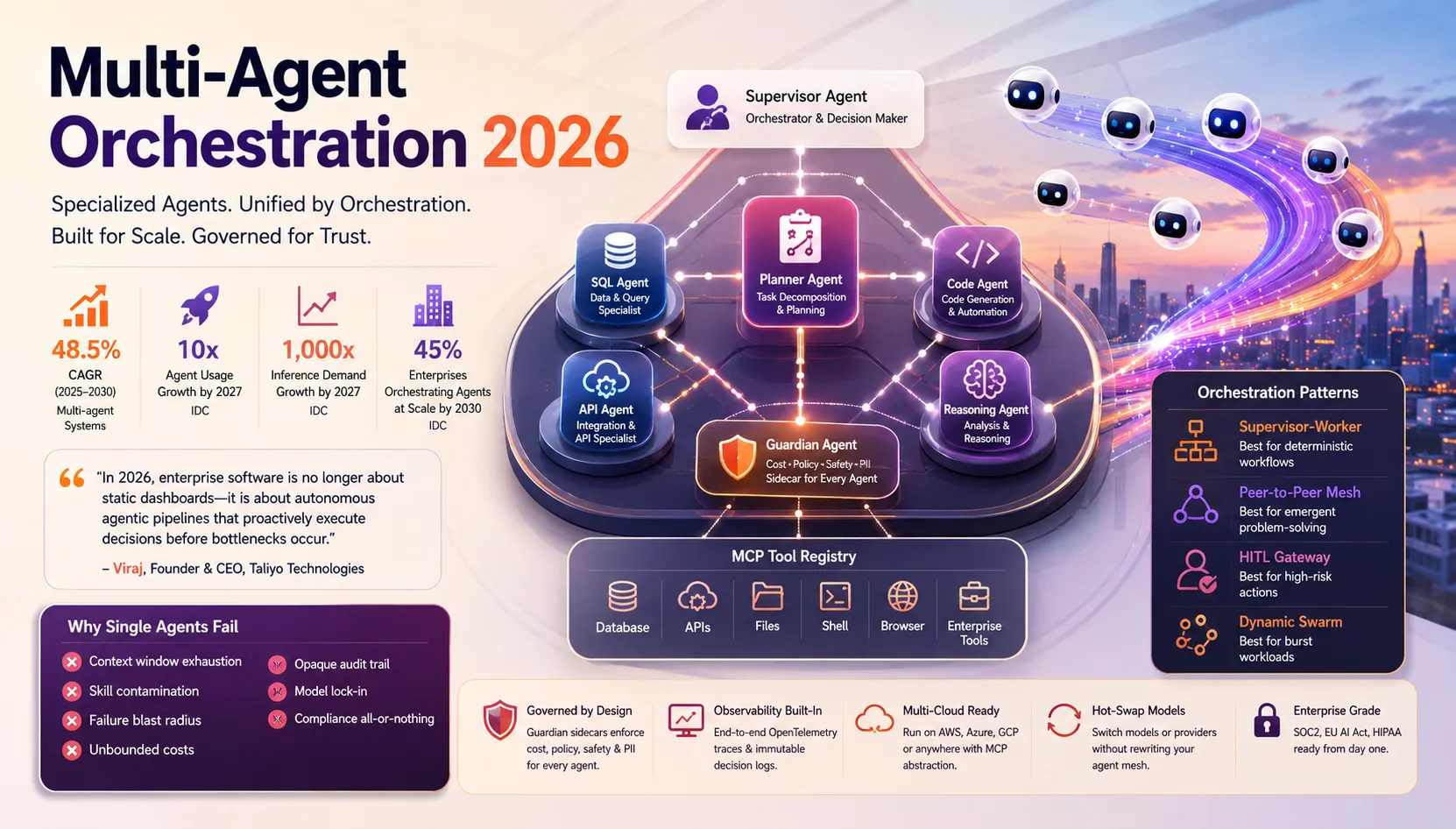
Multi-Agent Orchestration 2026: From Chatbots to Agent Mesh
Single-agent share drops from 59% to <35% by 2028. Multi-agent mesh delivers 3.7x ROI vs 2.1x. Taliyo Agent Mesh: MCP, Guardian, vertical packs.
 VirajRead

Taliyo ROI Acceleration Framework 2026: 4 Levers to Top-Quartile AI Agent Returns
Only 23% see AI agent ROI in 2026. Taliyo's 4 levers (hard gates, guardian cost, vertical packs, and continuous evaluation) deliver 5.2x+ in 3-5 months vs 3.7x industry.
VirajRead 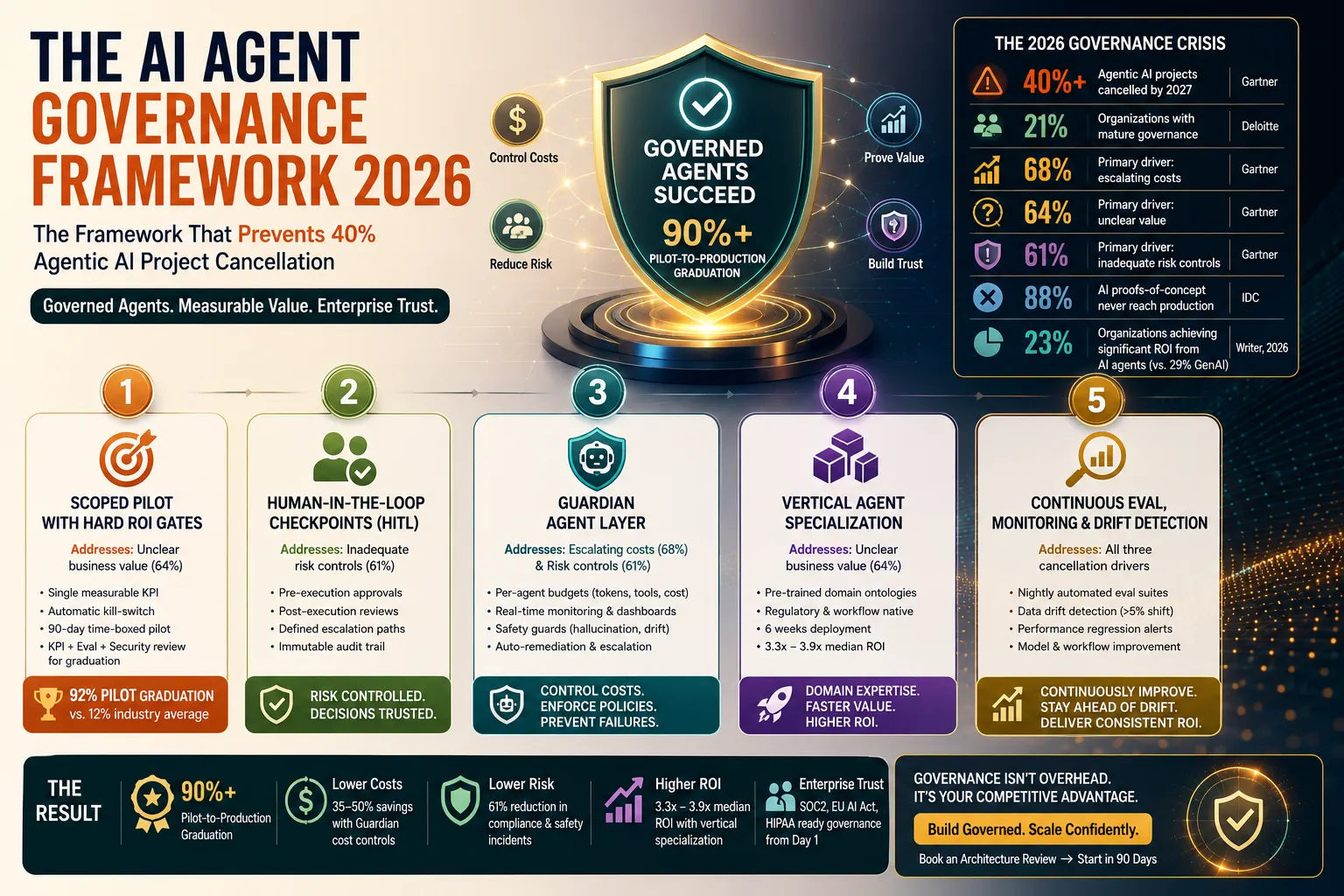
AI Governance Maturity Model 2026: From Chaos to Guardian-First
Only 21% of orgs have mature AI governance (Deloitte 2026). Average maturity: Level 1.4. Taliyo Guardian-First deploys at Level 4 from Day 1.
VirajRead